
Here’s a blog-style article draft for Global Fabrication inspired by the themes in the the “expanded metals” article, reworked into an original piece. Feel free to adapt the tone, examples, or structure as needed.
The Versatility of Expanded Metal in Modern Fabrication and Architecture
In an era when form and function must coalesce, expanded metal offers a compelling fusion of structural integrity, aesthetic potential, and sustainable advantage. At Global Fabrication, our mission is to push boundaries in metal design and fabrication—leveraging techniques like expanded metal to deliver solutions that are not just strong, but expressive, efficient, and adaptable.
In this post, we’ll explore how expanded metal works, the design levers architects and engineers can pull, its performance advantages (especially in sun control and structural efficiency), and why it’s gaining prominence in both commercial and residential projects. We’ll also look at key considerations when specifying expanded metal, plus some illustrative use cases. Toward the end, you’ll see how Global Fabrication can partner in bringing these possibilities to life.
What Is Expanded Metal?
At its core, expanded metal is a metal sheet that has been slit and stretched (rather than punched) to form a grid of diamond-shaped (or sometimes hexagonal or custom) openings. Because the process stretches the metal, there is minimal waste: you don’t lose circular cutouts as with perforated metal, and the final piece remains a single unit with no weak points that can unravel.
Key Characteristics
- Continuous strands and bonds: The metal forms strands (the solid webs) and bonds (the intersections). These define the geometry and structural behavior.
- Open area vs. solidity: The ratio of open area (void) to solid material is a critical design variable. Larger openings increase transparency and allow more light, while narrower strands produce stronger panels with less transparency.
- Strand orientation and flattening: Expanded metal panels may be left in their as-expanded (3D) form or flattened (pressed to a uniform plane). Flattened panels provide a more planar surface and often better visual uniformity, whereas raised (unflattened) strands create interesting light patterns and depth.
- Material options: Expanded metal can be fabricated in various metals—steel (galvanized, stainless), aluminum, copper, and more—depending on strength, weight, corrosion resistance, or aesthetic goals.
Because of these attributes, expanded metal is not just a decorative grille or screen—it’s a structural component that can carry loads, span openings, provide shading, and serve multiple performance roles.
Design Flexibility: Levers Architects and Engineers Use
One of the exciting aspects of expanded metal is how many variables designers have at their disposal. Here are some of the primary levers and trade-offs to consider:
1. Strand Width & Pitch
Changing the width of the webs (strands) and the pitch (distance between strands) lets you dial in the balance between strength, openness, and light transmission. Fine strands with tight pitch yield high strength and limited transparency; wide strands with larger pitch allow more daylight and views.
2. Diamond Aspect Ratio
The shape of each opening—its long side vs. short side—affects directionality, visual scale, and light behavior. Long, skinny diamonds emphasize linearity; more equilateral diamonds yield more isotropic patterns.
3. Orientation & Angling
Panels can be oriented with the long axis of the diamonds vertically, horizontally, or rotated. In façade use, panels can even be installed perpendicular to the building skin (rather than flush). This allows the openings to catch light and shadow dynamically as the sun moves across the sky.
4. Flattening / Pressing
Flattened expanded metal offers a more uniform surface and can reduce glare or visual irregularities. On the other hand, a 3D, raised profile can scatter light and create richer textures of shade, introducing dynamism to façades.
5. Modular Framing and Seams
Expanded metal panels can be designed to butt seamlessly, nested into frames, or stair-stepped. Designers may cut at the bond (intersection of two diamonds) to maintain continuity across panels. Whether recessed, flush, or framed, the visual and structural relationships matter.
6. Coatings, Color & Finishes
After expansion and cutting, metal panels can be powder coated, painted, anodized (for aluminum), or otherwise finished. The finish must be applied after expansion to ensure the edges and apertures are protected. Color, gloss, texture—all influence the visual impact and longevity.
7. Curved or Bent Forms
Because expanded metal is continuous and flexible to an extent, it can be curved or bent (within limits) to wrap corners or conform to nonplanar surfaces. This morphability opens up creative opportunities in architectural envelopes or sculptural elements.
Performance Advantages: Beyond Just Looks
Expanded metal isn’t purely decorative. Its physical and thermal performance can deliver compelling benefits—some of which support energy efficiency, occupant comfort, and sustainable goals.
Sun Control & Daylighting Modulation
One of the most strategic uses of expanded metal is as a passive shading or daylight control element:
- When placed in front of glazing, the strands block direct solar radiation while still permitting filtered daylight. With proper orientation and geometry, expanded metal can reflect or diffuse up to 85 % of incident light that would otherwise penetrate the glass.
- As the sun angle changes, the sash of the expanded metal interacts with light to breakup strong beams, reduce glare, and preserve visual comfort deeper in the space.
- Because it is fixed (i.e. not adjustable like operable louvers), the dimensions of the panel must be optimized to the solar angles unique to the project site, latitude, and orientation.
By reducing solar heat gain, the cooling load on the HVAC system can fall, which yields energy savings and more stable internal temperatures.
Structural Efficiency & Weight Savings
Compared to solid plates or perforated steel that requires punching, expanded metal offers excellent strength-to-weight ratios thanks to the continuous strands and bonds. It can span moderate distances with minimal framing, reducing material and installation costs.
Moreover, the absence of offcuts or waste in the expansion process means a more efficient material yield; every bit of slit metal is part of the final product.
Sustainability & Recyclability
Since the expansion process doesn’t discard material, expanded metal is inherently more resource-efficient than punched alternatives. Also:
- It is nearly 100 % recyclable.
- Many raw metals used in expanded metal already contain recycled content (20–40 % is common).
- Use of expanded metal can contribute toward green building certifications (e.g. LEED) by virtue of its recycled content and material efficiency.
Durability & Maintenance
When made from corrosion-resistant materials (e.g. stainless steel, aluminum, or appropriately coated steel), expanded metal resists weathering, abrasion, and vandalism. Cleaning is typically straightforward, and because it is a rigid, continuous surface, there are fewer joints or voids that trap dirt.
Architectural & Fabrication Use Cases
Here are some concrete ways expanded metal is being used—and how Global Fabrication can enable these:
Exterior Facades & Sunshades
Expanded metal makes an excellent façade cladding or sunscreen. Panels can wrap building faces, shade glazing, or serve as brise-soleil. Their 3D or planar profiles can give iconic identity to a building envelope.
Example: A commercial office tower in a sunny climate used expanded metal panels mounted flush to the façade. The engineered strand geometry allowed daylight to filter in while keeping interiors cooler and mitigating glare. The façade became a visual signature, with a subtly shifting play of light and shadow.
Operable Shutters & Ventilated Screen Walls
Though expanded metal itself is fixed, individual panels (or groups of panels) can be mounted on hinges or tracks to act like shutters. In projects where occupants want control over daylight, these can be linked in accordion fashion so that panels swing open or closed.
In schools or mixed-use buildings, operable expanded metal shutters provide daylight management, security, and ventilation while maintaining a consistent architectural expression.
Canopies, Walkways & Pergolas
Walkways, outdoor corridors, and entrance canopies benefit from shading. Expanded metal panels overhead filter sunlight, providing relief without fully darkening the space. In campus environments or mixed-use developments, interconnected paths covered with expanded metal canopies create a unified aesthetic and cooler pedestrian experience.
Interior Partitions & Decorative Screens
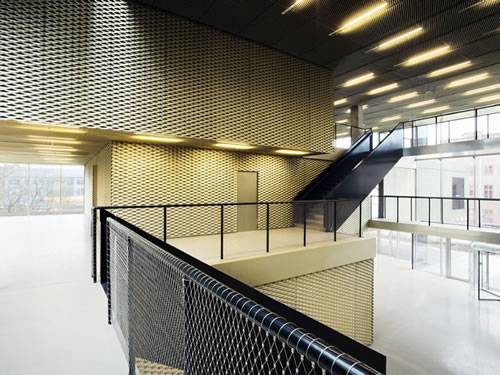
Inside buildings, expanded metal can serve as partitions, balustrades, stair risers, ceiling panels, or decorative screening. It combines transparency with enclosure, making it ideal where visibility and airflow are desired. The dimensional depth adds texture; bending or folding allows sculptural forms.
Infrastructure & Industrial Applications
In utility, mechanical, or industrial settings, expanded metal is used for grating, walkways, safety guarding, trench covers, ventilation screens, and machinery guards. Its strength, open area, and robustness deliver practical functionality.
Custom Sculptural & Branding Elements
Because expanded metal can be cut, shaped, folded, or curved, designers can exploit it for custom signage, signatures, lattices, or façade transitions. Branding elements such as corporate logos or perforated patterns can be integrated directly into the expanded geometry.
Considerations When Specifying Expanded Metal
To ensure successful performance, design coordination, and fabrication, several considerations must be addressed:
Orientation & Solar Modeling
Because expanded metal is fixed, designers must model sun angles and simulate how various strand geometries will perform in situ. Solar studies (sun path, shading diagrams) help optimize the diamond aspect ratio, pitch, and orientation for minimizing peak loads and glare.
Aligning with Window and Glazing Design
When expanded metal screens cover windows or façades with operable glazing, the design must allow for occupant views and ventilation. That often means selecting larger diamond openings (for example, 127 mm or ~5 in along the long side) so that views outward aren’t overly blocked.
If panels are mounted flush over fixed glazing, careful calibration is needed to balance openness and sun screening.
Panel-to-Panel Continuity
When designing multi-panel systems, decisions about panel seams, offsets, and tolerances matter. Cutting at the bond (intersection between diamond units) maintains continuity. Mounting flush or offset, inset or proud—all influence the visual rhythm and shadow lines.
Structural Framing & Support
Because expanded metal spans between supports, framing must account for deflection limits, wind loads, and fastening strategies. Depending on span lengths and loads, extra bracing or intermediate supports may be required. The panel must be integrated with a robust substructure that accommodates thermal expansion, nesting, and attachment points.
Finishing & Protective Coatings
All finishing should happen after expansion and cutting. If you paint or coat the metal before expansion, the slit edges will be raw, uncoated metal—leading to potential corrosion or visual inconsistency. Post-processing techniques (powder coat, anodizing, wet paint, fluoropolymer finishes) must be chosen for durability in the local climate.
Maintenance and Access
Though expanded metal is generally low maintenance, in humid, salty, or polluted environments periodic cleaning may be needed (e.g. washing off salts or particulates). The access strategy (walkways behind panels, removable modules) should be considered.
Fabrication Tolerances & Panel Weight
Designers should understand weight per square meter (or foot) and the sheet size limitations for transport and installation. Very large panels may be more challenging to ship or handle. Coordination with the fabrication partner is critical to ensure panels can be safely handled, hoisted, and installed.
At Global Fabrication, we account for these constraints during the design phase so that clients aren’t surprised by impractical panels on site.
Why Choose Expanded Metal (Especially from Global Fabrication)?
Holistic Efficiency & Material Yield
Because expanded metal is manufactured via slitting and stretching, there is no scrap from punched holes—the yield is nearly 100 %. This makes it more economical and resource-efficient than punched perforated metal.
Balanced Strength & Lightness
Expanded metal offers one of the best strength-to-weight ratios among open-area metals. Its continuous network of strands and bonds allows it to span greater distances with less framing, reducing dead load and structural cost.
Daylight, Ventilation & Comfort
When well designed, expanded metal acts as a passive shading device—reducing solar heat gain, managing glare, and promoting more even daylight distribution. In naturally ventilated spaces, it also facilitates airflow without sacrificing enclosure.
Durability & Low Lifecycle Cost
With proper material choice and coatings, expanded metal resists corrosion, abrasion, and environmental stress. It typically demands minimal maintenance and offers a long service life—lowering lifecycle costs.
Aesthetic Identity & Branding
Expanded metal allows subtle control of scale, pattern, depth, and light interplay. Designers can create signature façades and screens whose appearance subtly shifts with daylight, delivering visual interest while tying into corporate identity, branding, or architectural narrative.
Sustainability & LEED Potential
Because the process is waste-minimizing and the material is recyclable, expanded metal aligns well with green building goals. The recycled content and resource efficiency can support LEED and other sustainability certifications.
Case Illustrations & Hypothetical Scenarios
To bring this into sharper focus, here are some illustrative (and partially hypothetical) applications.
Case A: University Lecture Hall Shading
A university in a warm climate wants an iconic lecture hall. The southern façade features expansive glazing to emphasize openness, but solar heat gain is a concern. Designers opt for expanded metal panels mounted just in front of the glazing. By modeling the sun angles over the year, they choose strands that block summer sun while admitting low-angle winter light.
In practice, these panels reduce cooling load, maintain excellent interior daylight, and provide a textured shadow pattern that celebrates the passage of time through the day. Maintenance access is enabled via a walkway behind the façade; modular panels can be replaced if needed.
Case B: Mixed-Use Tower Envelope
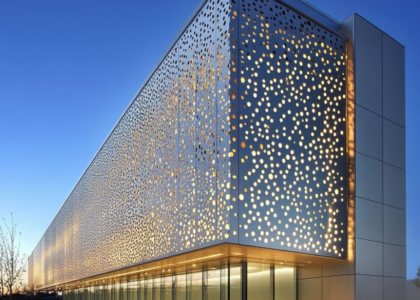
A mixed-use high-rise uses expanded metal as a semitransparent skin wrapping the entire tower. The panels are mounted slightly outboard, creating a ventilated double-skin effect. The diamond pattern is varied subtly as it climbs—becoming more open above certain levels to allow more views, and tighter below where sun is more intense.
Because expanded metal is continuous, the façade reads as a single, coherent expression. At night, internal light glows through the apertures, giving the tower a soft, perforated lantern quality.
Case C: Pedestrian Promenade Canopy
In an urban plaza, a long pedestrian canopy uses expanded metal as the overhead surface. The metal filters sun, casting dappled shade below. The designer bends the panel edges to curve down toward columns, creating fluid transitions. The open area provides sufficient daylight, while reducing direct sun and creating visual connection to the sky.
Case D: Interior Partition & Stair Balustrade
An architecture firm wants a light, visually permeable partition between an open office and conference zone. Expanded metal makes an ideal screen: it provides some visual separation but doesn’t block sightlines entirely. Meanwhile, steel plates are incorporated as accents or signage. The entire assembly becomes a custom architectural feature rather than a generic divider.
Tips for Working with a Fabricator (Like Global Fabrication)
To get the most from expanded metal, here are tips and insights to guide the client–fabricator relationship:
- Involve us early: Bring your expanded metal ideas into the design phase. We can run solar simulations, structural checks, and suggest optimizations early—saving cost and change orders later.
- Iterate sample panels: Prototyping small panels lets you test light, shadow, daylight penetration, and appearance in context before committing.
- Model with real weights and tolerances: Don’t assume “thin and light” is always better—transport, lifting, deflection, and installation constraints may push toward more robust options.
- Coordinate attachment and structural supports: Panels don’t exist in isolation: integration with mullions, frames, substructure, and anchors must be precise.
- Specify coatings post-expansion: Always finish the panels after they’ve been slit and expanded; otherwise, edges will remain uncoated and vulnerable.
- Consider modular replacement: Design for replacement or access zones, especially in façades exposed to stronger environmental conditions or potential damage.
- Communicate site constraints: Provide us with information about crane access, hoisting paths, available staging, and how panels will be installed on-site.
- Plan maintenance and cleaning: In corrosive or dusty environments, periodic cleaning or inspections may be necessary. Design access behind or in front of panels where feasible.
- Think beyond the façade: Expanded metal’s versatility means it can be structural, decorative, functional, or some mix. Talk with your fabricator about hybrid uses.
Why Partner with Global Fabrication on Expanded Metal Projects?
Global Fabrication is not just a metal shop—we are your collaborative partner from concept to installation. Here’s what sets us apart:
- Engineering & design support: We provide upfront assistance in solar modeling, structural analysis, and fabrication optimization to reduce surprises.
- Precision and quality control: Our fabrication standards, cutting tolerances, welding practices, and finishing workflows ensure panels arrive site-ready.
- Flexible material expertise: Whether your project demands stainless steel, aluminum, corten, or specialty alloys, we bring the metallurgical knowledge to deliver durability and aesthetics.
- Customization & innovation: From custom diamond geometries to curved panels, branding patterns, and hybrid material assemblies, we thrive on the bespoke.
- Logistics and installation guidance: We assist in packaging, shipping, handling, and site coordination so that panels arrive undamaged and are installed efficiently.
- Sustainability alignment: We help clients tap the environmental advantages of expanded metal—minimal waste, recycled content, and long lifecycle performance.
When you choose Global Fabrication for your expanded metal needs, you’re selecting a collaborator that understands not just steel and aluminum, but how to turn them into expressive, high-performance architecture.
Conclusion
Expanded metal offers a rare synthesis of efficiency, structural integrity, and expressive design potential. When used thoughtfully, it becomes more than a screen or grille—it becomes an active component in energy management, visual identity, and spatial experience.
At Global Fabrication, we’re eager to help you explore the possibilities. Let’s talk about how we can integrate expanded metal into your next project—whether as shading screens, façade skins, partitions, or more inventive uses. Visit us at www.gofabllc.com for more information or call us at (228) 282-5575 for a quote.